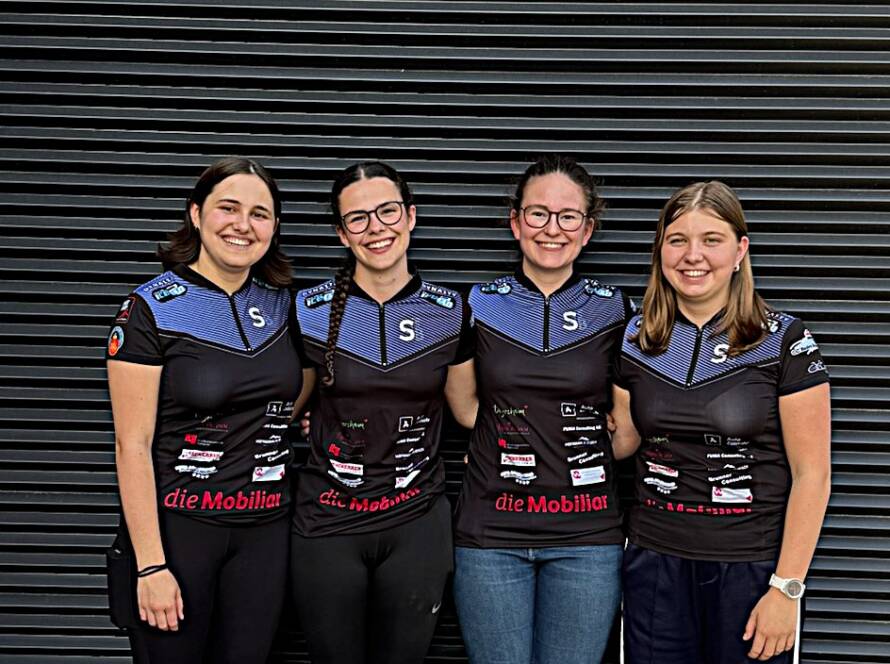

There are career moves in sport that look sudden only from a distance. A name appears on an elite team sheet, a young player is announced alongside world champions, and the story is presented as a breakthrough. But in curling, as in every precision sport, breakthroughs are rarely accidental. They are built end by end, weekend by weekend, across cold rinks, early-season tests, long bus journeys, hard losses, and the kind of international tournaments where young athletes learn not only how to win, but how to belong.
Renée Frigo’s rise from junior competition to the newly rebuilt elite team of Alina Pätz is one of those stories.
Renée Frigo’s Leap into Team Pätz Shows the Power of Junior Curling
Last year, Frigo was competing at the EJCT Baden, a junior event designed to sharpen teams at the beginning of the season. Now, she has been called into one of the most closely watched teams in Swiss and international women’s curling. Following the departures of Silvana Tirinzoni and Carole Howald, Alina Pätz and Selina Witschonke have completed their new line-up with Renée Frigo and Stefanie Berset. Swiss media reported the move in mid-May, with Frigo, then 21, described as a player who had represented Switzerland at the Junior World Championships earlier in the spring.
For Frigo, this is more than a promotion. It is a passage from development curling into the arena where expectations are immediate, margins are brutal, and every stone carries consequence. From EJCT Baden to a real chance of playing Grand Slam curling, her trajectory is a powerful success story for Swiss junior curling and a reminder of why international junior events matter.
The headline name, of course, is Pätz. Alina Pätz is not simply rebuilding a team; she is carrying forward one of the most successful modern legacies in women’s curling. World Curling listed Pätz as a six-time world champion before the 2026 Olympic Games, and as we all know Tirinzoni and Pätz, won silver in the women’s curling final at Milano Cortina 2026 after a narrow defeat to Sweden. (World Curling)
That medal mattered. It completed a long pursuit for a Swiss group that had dominated world championship curling but had repeatedly found the Olympic podium elusive. It also closed a chapter. Tirinzoni’s retirement and Howald’s move away from the team left a vacuum not only of experience, but of identity. The Swiss powerhouse needed to become something new. Pätz, long celebrated as one of the great shot-makers in the game, now steps into the role of skip of her own team. Grand Slam of Curling also reported the new formation, noting that Pätz would return to skipping with Witschonke, Frigo and Berset in the line-up.
That is the context into which Frigo enters. She is not joining a quiet rebuild hidden from public attention. She is joining a team that will be measured against championship standards from the first draw. The jersey may be new, the structure may be reshaped, but the expectations remain Swiss-sized: excellence, consistency, international relevance.
For a former junior, that can be intimidating. It can also be the ideal environment.
Frigo’s profile tells us why. She comes from the junior pathway with meaningful international exposure, national-team experience and the resilience that junior championships demand. According to Swiss Curling, the Swiss junior women finished fifth at the Junior World Championships in 2026, with Frigo listed among the team members. (Swiss Curling) Sporthilfe’s athlete profile for Frigo also lists a fifth place at the Junior Women’s World Championship in the 2025/26 season, alongside earlier junior successes including Swiss A-League junior champion status and victories at EJCT Thun, the U21 Ahsam Slam and the SwissCup in 2024/25.
Those results matter because they show a player who has not been selected on promise alone. Frigo has already moved through pressure formats. She has already been part of teams asked to represent Switzerland, not just themselves. She has already felt the difference between a promising junior event and the unforgiving edge of international championship curling.
That is where EJCT Baden enters the story
The European Junior Curling Tour is more than a calendar of tournaments. For young players, it is a laboratory. It gives teams the early-season chance to test line-ups, systems, communication and temperament against opponents from other countries. It exposes players to unfamiliar ice, unfamiliar rhythms and unfamiliar styles. In a sport where tactical patterns can differ subtly from nation to nation, those weekends are invaluable.
Frigo herself puts it clearly
 “My team and I really benefited from the EJCT Baden. As it takes place at the start of the season, it is a great opportunity to play against other junior teams and see where you stand as a team. It is a strong start to the season and helped us to understand what we need to work on and improve to get ready for the season as the junior Swiss national team.”
That quote could serve as the tournament’s mission statement. Baden was not just another stop on the calendar. It was a measuring point. It told a team where it stood before the season had fully formed. It exposed weaknesses early enough to address them. It created competitive pressure without the finality of a championship. It allowed players to make mistakes, gather data, refine communication and return to training with sharper purpose.
For junior curlers, that process is essential. A junior world championship is not won in one week. It is prepared months earlier, often in events that do not receive national headlines. The opening draws in September, the tight games against unfamiliar teams, the tactical discussions after a missed chance, the experience of playing several games in a compressed period — all of it forms the foundation.
Frigo’s move to Team Pätz is therefore not only a personal achievement. It is evidence that the pathway works. It shows that junior tournaments can help produce players ready to step into elite environments. It demonstrates to younger curlers that the distance between a junior event in Baden and a Grand Slam sheet is not imaginary. It is long, demanding and uncertain, but it is real.
That matters especially in Swiss curling, where the top of the women’s game has been dominated by extraordinary names. Tirinzoni, Pätz, Howald and Witschonke built an era of sustained excellence. They collected world titles, European honours, Grand Slam victories and finally Olympic silver. Replacing parts of such a team is never simply about filling positions. It is about blending generations. It is about preserving standards while allowing new voices to grow.
Frigo’s challenge will be technical, tactical and emotional.
Technically, the jump from junior to elite women’s curling is significant. The weight control is less forgiving. The sweeping standards are higher. Opponents punish half-mistakes. Ends can turn on a single over-curled guard, a missed peel, a draw that slides a foot too deep. At Grand Slam level, there are no soft games, no long passages where a young player can hide. Every throw is logged in the mind of the opposition.
Tactically, she will have to adapt to a team led by Pätz, one of the best late-end players of her generation. Playing with a skip of that calibre can be liberating because the structure around you is strong. It can also be demanding because elite skips expect precision in execution and clarity in communication. The new Team Pätz will need to build trust quickly: in line calls, in sweeping decisions, in game plans, and in how the team reacts when pressure rises.
Emotionally, Frigo will need to embrace the scale of the opportunity without being swallowed by it. That is often the defining test for young athletes promoted into elite teams. The talent gets them there. The environment determines whether they can grow. In this case, the environment could be ideal. Pätz and Witschonke bring championship experience. Berset brings her own high-level background, having recently been part of Corrie Hürlimann’s team and having represented Switzerland in mixed doubles alongside Philipp Hösli, according to SDA reporting carried by Bluewin.
This is not a rebuild based only on youth. It is a structured renewal. A decorated leader. An established teammate. A mature addition. A young player with upside. That combination gives Frigo room to develop while still being held to elite standards.
The significance extends beyond one team. For organisers of junior events, coaches, clubs and parents, Frigo’s story is a strong argument for investing in international competition at development level. Training matters. National championships matter. But young curlers also need to experience the wider game. They need to see how a Scottish junior team manages tempo, how a Scandinavian team approaches aggressive calls, how Swiss precision holds up under pressure from unfamiliar systems. They need to learn travel routines, recovery habits, communication under stress and the emotional discipline of tournament play.
EJCT Baden offers that kind of stage. Its value is not only in the scoreboard. It is in the questions it asks. Can a team start the season sharp? Can it adapt during a weekend? Can it identify weaknesses without panic? Can players handle pressure in September so that they are better prepared in February or March?
Frigo’s answer, based on her own words, is yes. Her team used Baden as a diagnostic tool, a competitive rehearsal and a launchpad into the season. That is exactly what strong junior tournaments should be.
Now the next phase begins.
The move to Team Pätz does not guarantee Frigo a smooth ascent. Elite sport does not offer guarantees. She will face tougher opponents, more scrutiny and higher internal expectations than ever before. There will be games where the learning curve feels steep. There will be moments when the pace of the elite tour reveals the difference between potential and finished product.
But the opportunity is exceptional.
To practise with Alina Pätz is to learn from a player whose career has been defined by decisive stones under pressure. To compete beside Selina Witschonke is to absorb the habits of a curler who has lived inside a championship team structure. To share a rebuild with Stefanie Berset is to be part of a team that is not merely preserving the past, but actively designing its future.
For Swiss curling, that future is important. Tirinzoni’s retirement marked the end of one of the sport’s great chapters. But successful nations are not judged only by their champions; they are judged by their succession planning. They must turn juniors into contenders, contenders into professionals, and professionals into medal threats. Frigo’s selection suggests that Switzerland is still doing that.
From the outside, the move may look like a leap. From inside the sport, it looks like the result of a pathway: club development, national junior structures, international junior tournaments, junior world championship experience, and finally the trust of an elite skip prepared to build with a younger player.
That is why Renée Frigo’s story should resonate beyond her own rink.
It tells every junior curler that the early-season games matter. It tells tournament organisers that their work can shape careers. It tells coaches that exposure and experience are not luxuries, but necessities. And it tells the next generation that the road from EJCT Baden to the Grand Slam spotlight may be difficult, but it is open.
For Frigo, the stones now get heavier. The arenas get bigger. The names across the sheet become more famous. But she arrives with something valuable: proof that she has already used the junior stage the right way.
She went to Baden to find out where she stood.
Now she stands in Team Pätz. We wish you and Team Pätz a successful season!